exploring the exploitative system of Indigo in Colonial India

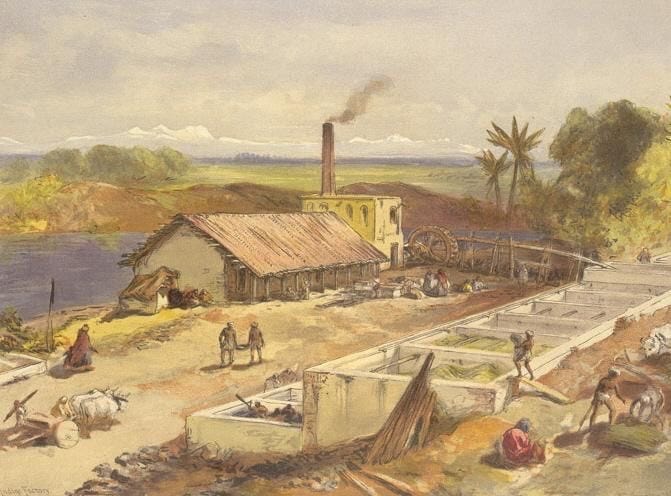
Your favorite pair of jeans used to be dyed with a dye that carries much historical and political meaning. It's currently dyed with synthetic indigo, but for most of human history indigo was the source of some of the richest, royal shades of blue.
The story of indigo is marred with human exploitation and struggle, but it also is central to resistance that was a cornerstone of the Indian revolution.
Indigofera tinctoria is the scientific name of the plant that has existed for thousands of years. Farmers in the Indus Valley were known to trade the small purple flowers that produced blue dye for gold and jade from Persia and Mesopotamia, and later Rome, Greece, and Egypt. Indigo's name is in fact derived from the Greek word indikon, meaning "from India." Of course, this also resulted in interest from Europe for a while. This was followed by a long-term ban on indigo in Europe due to an attempt to support the woad industry in Europe, a local product that produced blue dye.
The history of indigo in India is implicitly tied to the world's colonial history. European explorers began to venture into India with the goal of finding spices and also found indigo, as the ban on it had been lifted. In 1510, the Portuguese king declared a royal monopoly on indigo among other Indian products as they fought to have possession over the Indian Ocean.
The next wave of information about indigo from India came from a 17th-century French naturalist, Jean-Baptiste Labat, who wrote about indigo cultivation practices in an early text that dispersed indigo knowledge across the European world. His work was central to the beginning of indigo production in the Caribbean and the Americas.
Indigo accounted for a third of British dye consumption in the late eighteenth century. In the 1780s the majority of the indigo crops came from the Caribbean and the Americas. During this time, Britain was cut off from the crop source in America by the American Revolution, and they turned to India to support their demand.
John Prinsep is the East India Company merchant who is often held accountable for establishing the indigo trade in India. They established a ryoti system, where Indian peasant farmers (ryots) rented their lands from zamindars with an advanced payment for cultivating that land. They were coerced into using a large portion of their best land to cultivate the indigo, which they were paid less for than they would have been for food crops, which inhibited their ability to pay back their initial loans, thereby kicking off an exploitative cycle.
This system was hard on the farmers, and on top of the limitations that were put on their food crops, the indigo also exhausted their soil. The demand for indigo was incredibly high, and at the same time it took 2,000 square feet of land to cultivate enough indigo for an 8 oz disc of dye. Violence was also central to the preservation of this system.
All of this injustice culminated in March 1859, when the farmers had had enough and staged a revolt called the Indigo Revolution, or Nil Vidroha. The Nil Vidroha (Blue Mutiny) was a collective refusal by the farmers to grow indigo. It began in the Nadia district of Bengal and spread rapidly. Its leadership was decentralized, but support for the movement came from all sectors of Bengali society.
The British responded to this with the passage of the Indigo Act in March of 1860, which required planters to grow indigo on their plantations that year by law while forming a commission to investigate the system of indigo cultivation in Bengal. The testimonies that were presented there were dark, with E.W.L. Towner, a British officer, positing that "not a chest of indigo reached England without being stained with human blood."
In 1860, Dinabandhu Mitra also published his realistic tragedy play, "Nil Darpan" (Blue Mirror). It was the story of two Bengali families, Hindu and Muslim, that suffered together at the hands of two fictional planters, Mr. Wood and Mr. Rose. The play highlighted the exploitative debt process and the physical and sexual exploitation enacted by many planters. It was written and performed in accessible Bengali so that it could be understood as widely as possible.
Reverend James Long also set about translating it to English so that it could be distributed to the Indigo Commission. Through a mysterious set of errors, rather than a couple of copies being printed and distributed, over 500 copies of this English translation were printed and distributed as far as members of the British Parliament. It resulted in wider, more accurate press coverage of what was happening in Bengal during the Indigo revolts, and it largely brought more sympathy for the movement for justice. James Long, however, was convicted of criminal libel of the planters and jailed. His fine was paid by Kaliprasanna Singha, a well-known Bengali playwright.
In the meantime, Nil Darpan triggered a wave of politically charged plays across the country that held up more mirrors to exploitative practices. They restaged it in 1872 in Bengal after the initial wave of Indigo revolts were over. The British were so threatened by this in the coming years that they passed the Dramatic Performances Act of 1876, which gave them the right to censor or ban any performances.
The Nil Vidroha was largely successful in Bengal, but the system was simply moved to Champaran, Bihar. The system was legally codified there as tinkathia for decades. The tinkathia system specified that farmers were required to use 3/20ths of their land for indigo. In 1897 synthetic indigo dye began to rise in Germany and undercut the market for natural indigo, but the farmers in Champaran were still forced to continue growing indigo, especially once the First World War broke out and raised the demand for indigo once again.
In 1916 Raj Kumar Shukla, a farmer from Champaran, approached Gandhi at a congress in Lucknow about the unfair tinkathia system that he and others had been living under, and Gandhi arrived in 1917 with a team that included Rajendra Prasad, Brajkishore Prasad, and Acharya Kripalani.
Gandhi traveled across Champaran trying to understand the conditions of the farmers. He was eventually ordered to leave the region by the British, and he refused. This was one of his and the country's earliest exposures to the civil disobedience that featured centrally in India's fight for independence. When he was arrested, hundreds of tenants and supporters of the cause showed up, and this pressure caused his case to be withdrawn. He continued to collect testimonies of the injustices done to indigo farmers, and eventually the British government was forced to establish an enquiry committee in June 1917, which included Gandhi as one of its members. Later that year the report from the committee was shared, with recommendations that included the abolition of the tinkathia system and reparations to indigo farmers. The government then passed an order in alignment with these recommendations, and the indigo plantations in India began to decline.
This was one of the first big changes that occurred because of civil disobedience, and it prefigured much of what Gandhi's methods would be throughout his fight for Indian independence. Both prongs of the Indigo revolts feature different kinds of nonviolent protest and sharing of stories that brought about greater change and justice. Prasad himself said that the national movement was "only an edition of the work in Champaran on an immensely vast scale”.
Despite the fact that most of us will wear jeans colored with a synthetic version of indigo, Indians are finding ways to revive the practice of cultivating Indigo. At Hampi Art Labs there is currently an art exhibition called Blue Futures: Reimaging Indigo that “invites us into an immersive contemplation of indigo as more than a dye; it is a sensorial, spiritual, and political force.”
There is also research that supports the idea that indigo could be a more sustainable form of dyeing than the current synthetic system. Brands like NoName, Maku textiles or Rajesh Pratap Singh have started including natural indigo dye as part of their slow fashion ethos. Although Indigo has fashion and political implications around the world, Nil Vidroha made the weight of indigo specifically great in India, indigo’s origin.
This article is written by Nalini Venugopal and reviewed by Prarthana Bhat.